


25-09-2026
The Munsell System: How to Identify and Communicate Color in Industrial Applications

The Munsell System originated from a practical need: to describe a color without relying on terms such as “brick red” or “sage green”, which everyone may interpret differently.
Its creator, Albert H. Munsell (1858-1918), was an American painter and art teacher who introduced the method in 1905. More than a century later, Munsell notation still appears in technical standards and specification documents.
Understanding its logic, from notation to physical color charts, helps distinguish situations where a visual reference is sufficient from those where a measuring instrument is required.
What is the Munsell system
A teacher at the Massachusetts Normal Art School, Munsell considered color names misleading and sought a rational method based on decimal notation. He presented it in A Color Notation, while the color sample atlas was published in 1915.
The underlying idea is to place every surface color within an organized space based on three independent perceptual attributes, arranged in steps that appear approximately equal to an observer. Color is no longer identified by a name, but by a code that describes its position within the system.
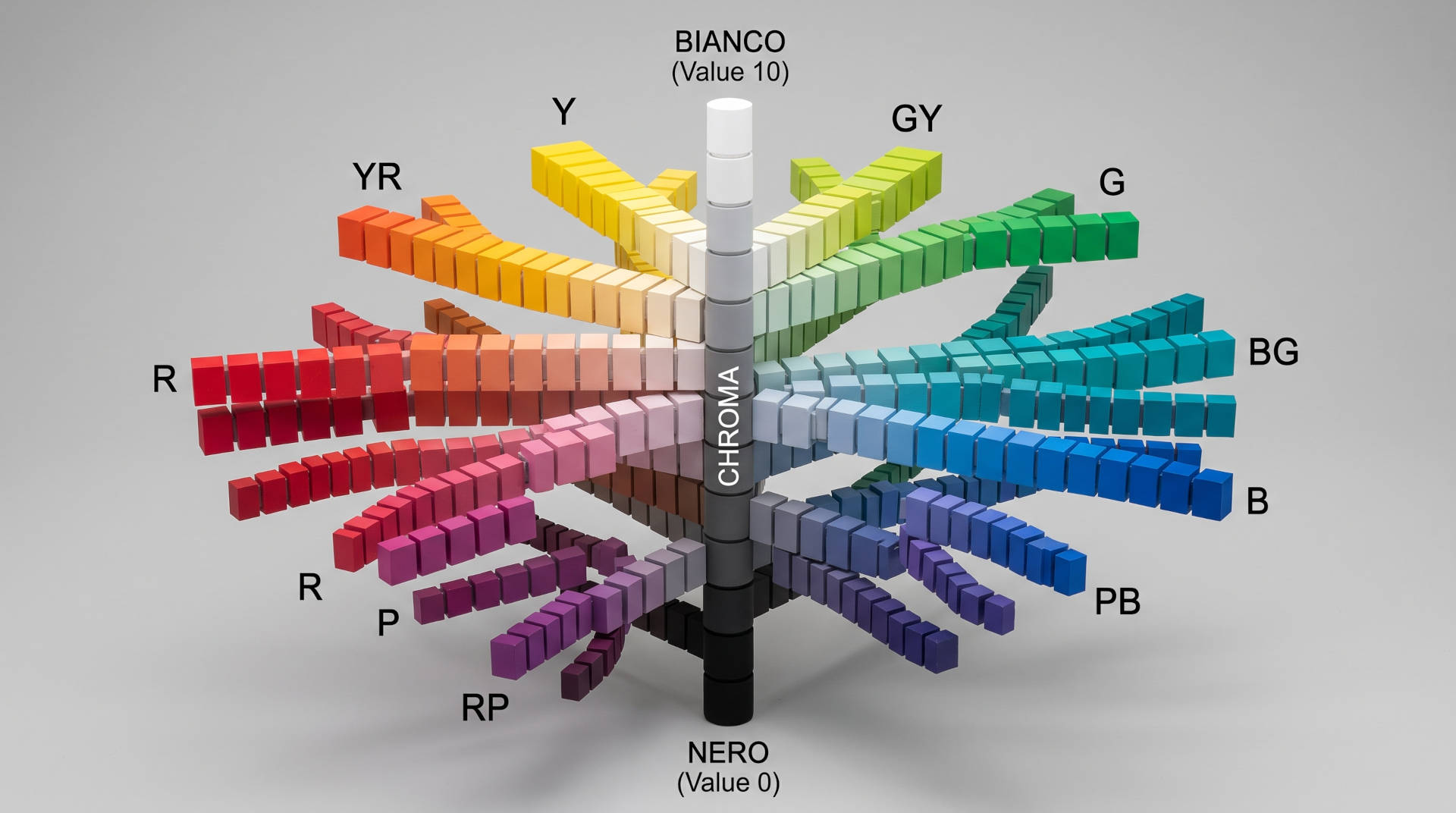
The system is represented as an irregular solid, the Munsell color solid, referred to as the Munsell color tree when represented as a physical model: samples mounted on plates that radiate from a central axis like branches from a trunk. Both the solid and the tree illustrate how the system is organized; they do not measure color.
The Munsell System is a system for color classification and notation, not an instrumental color measurement technique. Its modern definition derives from the revision carried out by the Optical Society of America in the 1940s, which expressed its colors in CIE coordinates, and it is now codified in ASTM D1535. Color atlases are a physical realization of the system, not its definition.
How does the Munsell system work: Hue, Value and Chroma
Each color is described by three independent attributes, always in the same order: Hue, Value and Chroma. For a general overview of these attributes in CIE color spaces, see the article on hue, chroma and lightness; here, the focus is on how Munsell defines them: perceptual scales, not physical quantities.
Hue: the color family
Munsell hue identifies the color family. The circle comprises five principal hues (red R, yellow Y, green G, blue B and purple P) and five intermediate hues (YR, GY, BG, PB and RP), each divided into ten steps, for a total of one hundred hues.
Value: lightness
Value expresses the lightness of a surface on a scale from 0, ideal black, to 10, ideal white. It does not correspond to brightness understood as the intensity of perceived light: it concerns a surface compared with a reference white and has a nonlinear relationship with the luminance factor Y of the CIE system.
It is correlated with perceived lightness, often referred to as brightness in everyday usage, but it does not correspond to the L* coordinate of CIELAB or to physical luminance.
Chroma: distance from neutral
Chroma measures how far a color is from the neutral gray of the same Value. The scale starts at 0, has no theoretical upper limit, and its effective maximum depends on hue and Value. At Value 4, for example, the 5R red reaches Chroma 14 in the atlases, while 5Y yellow stops at 6. It does not correspond to saturation, which expresses chromatic intensity in relation to the lightness of the color itself.
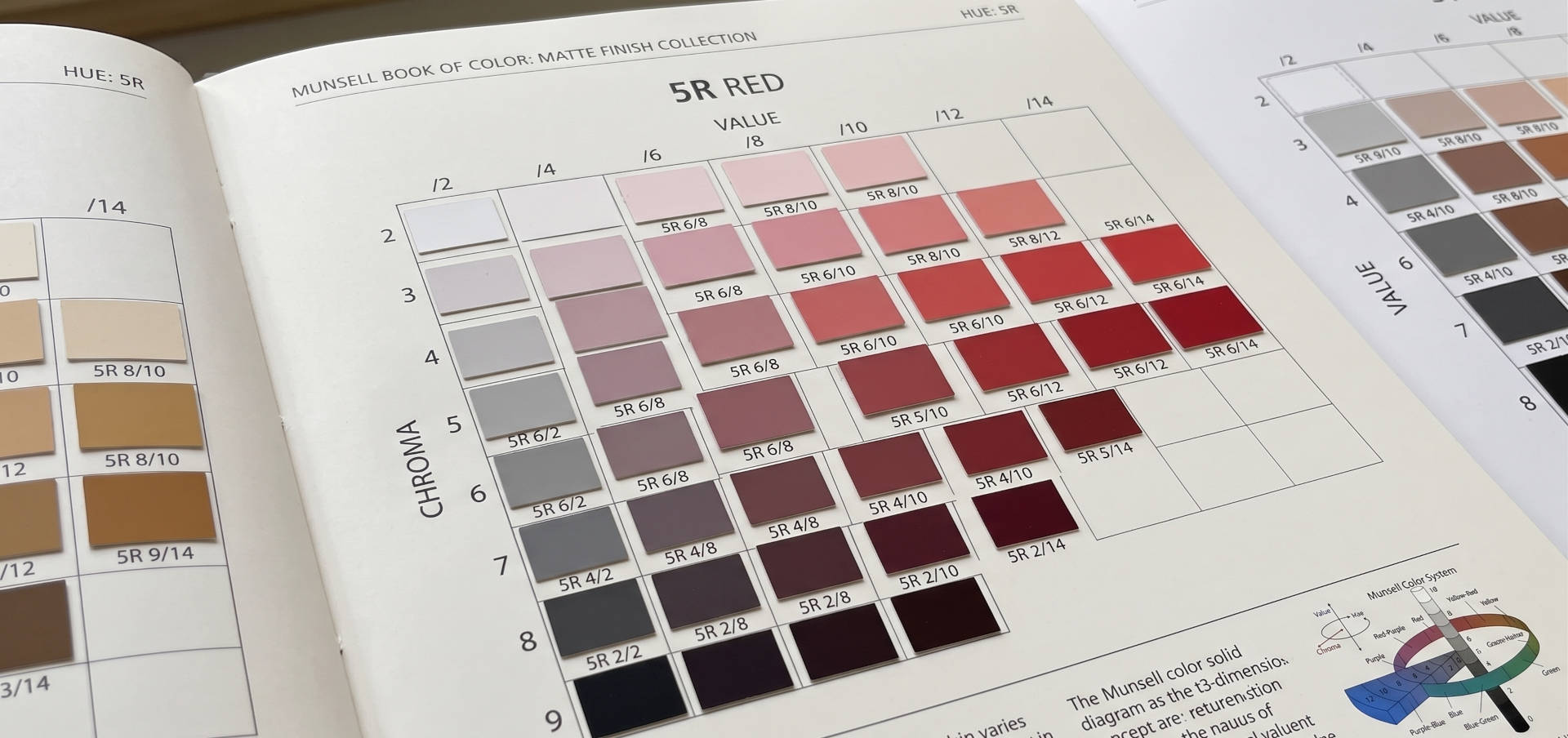
In the three-dimensional space, Value runs along the vertical axis of neutral grays, hue changes with the angle around the axis, and Chroma increases as it moves away from it. On paper, this structure is presented in Munsell color charts: each page has a constant hue, with Value arranged vertically and Chroma horizontally. In everyday language, these may be referred to as Munsell color charts or color tables, while the technical term is a constant-hue chart.
Only the three attributes together identify a color. Starting with the muted red 5R 4/4, changing just one dimension at a time shows what each attribute modifies:
- 5R 4/14: only Chroma increases, making the red more intense.
- 5R 8/4: only Value increases, making the color lighter, toward a pale pink.
- 5YR 4/4: only the hue changes, shifting toward orange.
How to read a Munsell notation
The notation takes the form H V/C: hue, Value and, after the slash, Chroma. A technical literature example is 5BG 5/8:
- 5BG: blue-green (BG), at the central position (5) within the hue family.
- 5/: Value 5, a lightness level midway between ideal black and white.
- /8: Chroma 8, eight units of distance from the neutral gray at Value 5.
Neutral colors have neither hue nor Chroma and are written with the letter N followed by the Value: N 5/ is a medium gray. Decimal values, such as 5.4R 6.2/12.4, indicate positions between physical samples and are obtained by interpolation.
The notation identifies and describes a color: anyone using the same system can communicate 5BG 5/8 without ambiguity. It is not, however, a measurement, because it indicates where a color is located within the system, not how much an actual sample differs from it.
Munsell, Pantone and RAL: what are the differences
The Munsell System is a color-ordering system defined by a technical standard: colors are arranged within a space using perceptual scales, and the notation describes their attributes. Reading 5R 4/14 indicates that it is a dark, highly chromatic red even without the physical sample. This makes it useful where a systematic color nomenclature is required, from visual comparison standards to the natural sciences.
Pantone and RAL, by contrast, use reference systems and collections of samples identified by specific codes. The Pantone Matching System, introduced in 1963, primarily concerns spot colors for printing, each associated with an ink formulation; the Fashion, Home + Interiors line, with TCX and TPG codes, is intended for textiles and products.
RAL Classic comprises 216 colors identified by a four-digit number, with the first digit indicating the color family, and is widely used in painting, construction and industry. In these systems, the code identifies a sample within a defined collection; in Munsell, it describes a position within a system that also includes colors absent from the atlas.
The three references serve different purposes:
- Munsell: describing and classifying a color according to perceptual attributes.
- Pantone: reproducing a specific color on a defined substrate, such as paper, textile or plastic.
- RAL: specifying a color belonging to a standardized, closed range.
None of the three, by itself, provides a measurement of the color of an actual product. For a broader overview, see the article on color models.

Where is the Munsell system used? Sectors and applications
Among the industrial sectors where colorimetry is applied, Munsell is generally not the primary reference for specifying product colors, but its role varies across different fields.
Paints and coatings
In paints and coatings, the documented references are more established. ASTM D1535 applies to opaque objects such as painted surfaces, while ASTM D1729 on visual evaluation uses Munsell notation to define the background and environment of viewing booths.
ANSI Z535.1 on safety colors also refers to the same notation, while ISO 3864-4 specifies them using CIE chromaticity coordinates and luminance factor. The aim is to describe a color and establish shared comparison conditions between manufacturer, customer and laboratory.
Textiles and apparel
In textiles and apparel, Munsell is not the standard: color is specified using collections of fabric samples and CIELAB measurements with tolerances.
Its contribution is historical and methodological, as it inspired color-difference formulas, such as the Nickerson fading index, as well as three-coordinate textile color atlases. The need remains for a common language among designers, dyers and suppliers.
Plastics, inks, leather and cosmetics
In plastics, inks and packaging, leather and cosmetics, Munsell is not a specification standard. Color is predominantly defined using CIELAB values and tolerances, often together with master samples, because production-lot control requires numerical data rather than classification alone.
A reference system can still be useful for sharing the target color among brands, formulators and suppliers, but verification relies on measurement.
Outside industry, one of the most established uses is in the natural sciences: the USDA adopted it in the 1930s for soil research.
Color charts: what they are and how they are used
A color chart is an organized collection of physical samples used to identify, compare and communicate a color: the sample being checked is placed alongside the reference, and the closest match is selected.
In practice, these terms are often used interchangeably, but they refer to different things:
- Color chart: a collection of samples organized according to a specific criterion, such as a color-ordering system or a product range.
- Color fan deck: a fan-shaped chart with foldable strips for quick color selection.
- Physical sample: an individual piece of colored material, such as a paint specimen or fabric swatch, used either as a standard or as the sample being evaluated.
- Color code: an identifier, such as 5BG 5/8 or RAL 3020, that refers to a sample or a position within a system without being the color itself.
Physical references have known limitations: the outcome of a visual comparison depends on the light source, observer, material and surface. To control these factors, ASTM D1729 specifies the light source, illuminance, geometry and background, conditions that can be achieved using light booths with controlled illumination.
A color chart therefore remains a visual and comparative reference: it indicates that one color resembles another, but not by how much they differ. For a quantitative assessment, an instrument is required.

Color reference and measurement: what is the difference?
A color reference system is used to identify, compare and communicate a color according to a shared convention.
A code, chart, fan deck or physical sample can be used to indicate “this color” and communicate it clearly, but none of these constitutes a colorimetric measurement: they lack a repeatable numerical value and a calculated difference from a standard.
Instrumental measurement, by contrast, provides coordinates in a color space such as CIELAB and makes it possible to express the distance between two colors as a number, ΔE.
Visual comparison with a physical reference is affected by several factors that measurement under defined conditions can control:
- Lighting and observation: the light source, illuminance, geometry and background can change the appearance of the same sample.
- Observer: color sensitivity varies from person to person and over time.
- Material and surface: gloss, texture and opacity affect the perceived color.
- Sample variations: uniformity, cleanliness and representativeness of the batch affect the result.
- Metamerism: two samples with different reflectance spectra may appear identical under one light source and different under another.
The two functions are complementary, not alternatives. The reference defines the target color according to a shared convention, while measurement provides the data needed to verify and control it from batch to batch in an objective and reproducible way, within an agreed tolerance.
The role of the spectrophotometer in color measurement
The spectrophotometer measures the light reflected from (or transmitted through) a sample at each wavelength of the visible spectrum, typically between 400 and 700 nm, and derives its reflectance spectrum.
With the illuminant and standard CIE observer defined, the software uses this spectrum to calculate colorimetric coordinates, such as those of CIELAB, as well as differences from a standard. The result depends on the sample and measurement conditions, not on the observer’s visual judgment, and can be compared across operators, locations and different periods.
Because the spectrum makes it possible to calculate how the sample appears under different illuminants, the instrument can also identify metamerism, which visual comparison alone can detect only with difficulty. There are benchtop versions for laboratory use and portable versions for measurements in production; its operation is explained in greater detail in the article on the spectrophotometer.

From Color Reference to Measurement
The Munsell system organizes color through three perceptual attributes, Hue, Value and Chroma, and translates them into a notation used to identify and communicate a color. It remains a classification system: like color charts, fan decks and physical samples, it describes a color but does not measure it.
The appropriate method depends on the objective. For describing or agreeing on a color, a reference may be sufficient; in industrial processes, where control and reproducibility are quality requirements, quantitative data obtained with instruments and defined conditions are needed.
The reference provides a common language, while measurement demonstrates that the color meets the required specification.
FAQ
What is the Farnsworth-Munsell test?
It often appears in searches as “Munsell test” or “Munsell color test”, but the correct name is the Farnsworth-Munsell 100 Hue Test, developed by Dean Farnsworth from the 1940s onward. It is not part of the Munsell notation system and does not measure the color of a product: it assesses a person’s ability to distinguish between hues. The subject must arrange 85 movable color samples, organized into four groups, according to chromatic progression, with practically constant lightness and chroma. For industrial visual assessment, ASTM D1729 requires observers with at least normal color vision, preferably with superior color discrimination according to this test.
What is the Munsell color solid?
It is the three-dimensional representation of the system’s color space, but it does not have the shape of a sphere or cylinder. Munsell initially started with a sphere in 1900, then found that, when the three scales were kept uniform, surface colors did not fit into any regular geometric shape. The outline also depends on pigments: the extent, particularly in Chroma, is limited by the colors that can actually be produced and may increase with more saturated colorants. The coordinates are defined for illuminant C and the 2° standard observer.
What are the three Munsell coordinates for colors?
They are Hue, Value and Chroma, always in that order. Hue is indicated by a letter designation and a number from 0 to 10 (or by a number from 0 to 100 around the hue circle), Value ranges from 0 to 10, and Chroma starts at 0 with no theoretical upper limit. For neutral colors, only Value is indicated. These are perception-based scales, not physical quantities such as wavelength or reflectance. Not all theoretical combinations of Hue, Value and Chroma correspond to surface colors that can be produced with pigments: the maximum Chroma varies with Hue and Value, which is what gives the Munsell color solid its irregular shape.
What are the Munsell color codes?
There is no list of codes linked to color names: each color has a notation consisting of three elements, and the system also includes intermediate values. Examples include N 5/ for a medium gray and 5P 5/10 for a purple of medium lightness. Online conversion tables to HEX or RGB are approximations: the system is defined for surfaces and illuminant C, while RGB values depend on the device. For a specification, the notation is more reliable or, preferably, the CIE coordinates.
How do you read a Munsell color code?
It is read from left to right: Hue, Value, slash, Chroma. A common mistake is to interpret the Hue number as a quantity, whereas it indicates a position around the hue circle, which proceeds clockwise from red to yellow: 9R is a red tending toward yellow, 1R tends toward purple, and 10R coincides with 0YR. In the atlas, the appropriate hue chart is selected, the row and column are identified and, if the color falls between two samples, it is interpolated.
Is the Munsell system a color measurement?
No, although its relationship with measurement is close. ASTM D1535 links each notation to CIE coordinates, so a Munsell notation can be calculated from a spectrophotometric measurement; in that case, the notation expresses a result already obtained with an instrument. On its own, however, it does not provide an overall color difference or tolerance, because the difference between two colors is defined one attribute at a time. For this reason, quality control uses calculated color differences in spaces such as CIELAB.

Subscribe to newsletter
You might be interested

Color Attributes: Hue, Chroma and Lightness in Industrial quality control
When a company decides to establish a color standard for ...

Inside the Colour Spectrum: from light to quality in Industrial processes
The colour spectrum is one of the fundamental concepts of ...

Colour Perception: from physiology to Industrial standardization
Colour perception represents one of the most complex phenomena in ...

ColorWorkDesk: your colourimetry with our consulting
Choosing a product like ColorWorkDesk means customising your colour management ...

ColorWorkDesk CWD Server: The software that provides colourimetry services
ColorWorkDesk CWD Server leverages server/cloud technology to centrally manage colour ...
Ask for a free consultation
Our experts will contact you to show you a demo of our products