


27-02-2026
Color Perception: from physiology to Industrial standardization

Color perception represents one of the most complex phenomena in the interaction between human beings and the surrounding environment.
Understanding why we see colors means analyzing a complex system that integrates the physics of light, the physiology of the human eye, and the neurological processing of the brain.
In the industrial context, understanding the mechanisms underlying color perception becomes essential for implementing reliable and standardized quality control systems capable of overcoming the subjectivity of visual evaluation.
How Color Perception occurs: the physiological process
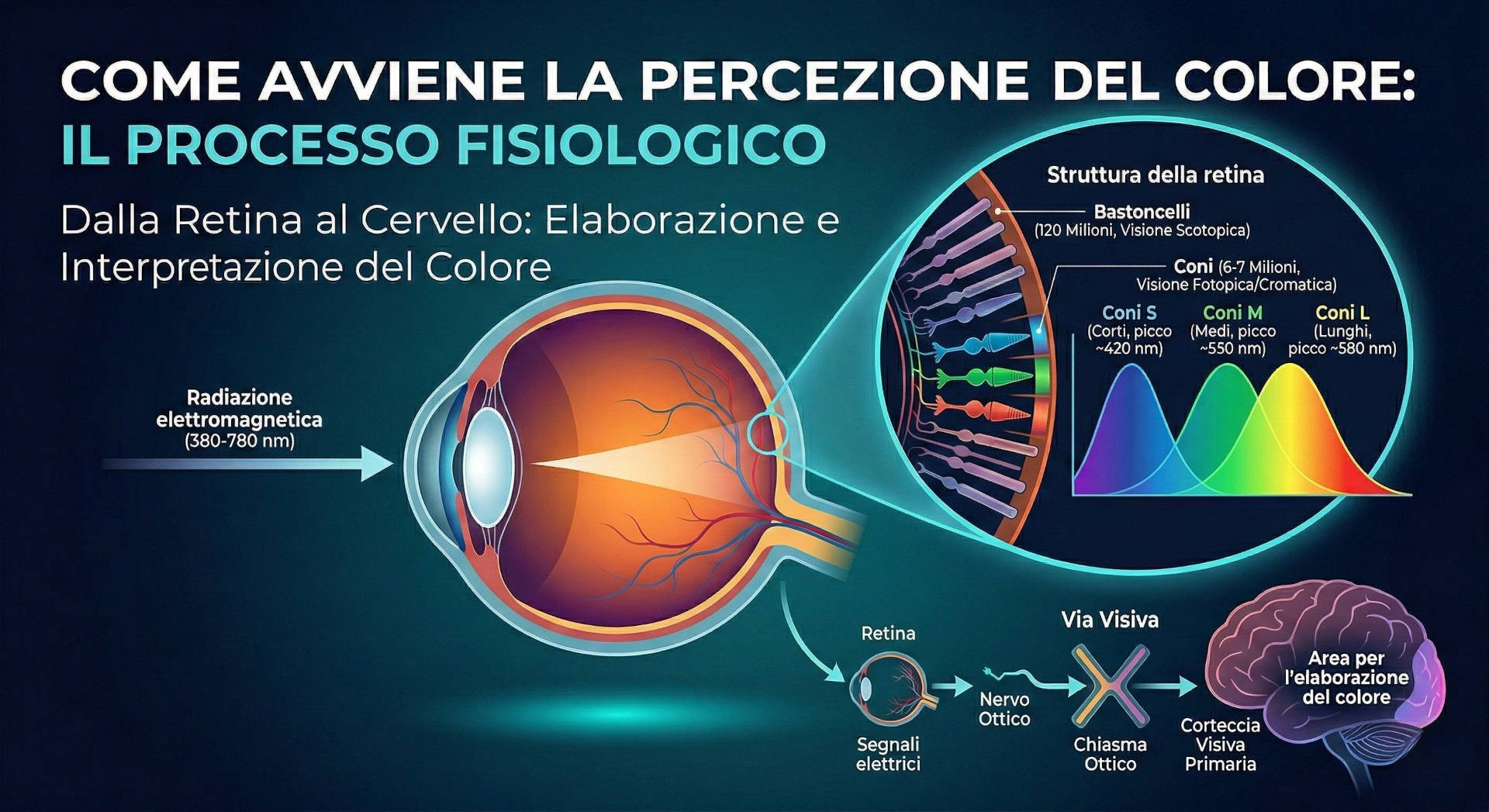
Color perception in the human eye begins when electromagnetic radiation, within the visible range approximately between 380 and 780 nanometers (400–700 nm in industrial colorimetry), passes through the cornea and reaches the retina.
The retina is the photosensitive tissue that transforms the light stimulus into electrical signals interpretable by the nervous system.
The retina contains two types of specialized photoreceptors, each with distinct functions:
- Rods, approximately 120 million per eye, are responsible for scotopic vision under low-light conditions. These photoreceptors do not contribute to color discrimination but provide high sensitivity to light, enabling the perception of shapes and movements even in near-total darkness.
- Cones, approximately 6–7 million per eye, concentrated mainly in the central fovea, are responsible for photopic vision and color perception. There are three categories of cones, characterized by partially overlapping spectral sensitivity curves: L cones (Long), with peak sensitivity around 560 nm; M cones (Medium), with maximum response around 530 nm; and S cones (Short), sensitive to short wavelengths around 420 nm. It is important to emphasize that cones are not sensitive to three “pure” colors (red, green, and blue), but to broad spectral bands whose relative combination determines the perceived color sensation.
The spatial distribution of cones across the retina is not uniform: maximum density is reached in the fovea, where chromatic and spatial resolution are optimal.
This anatomical configuration explains why color perception is more accurate in central vision compared to peripheral vision, where rods predominate.
How Color Perception works: neurological interpretation and theoretical models
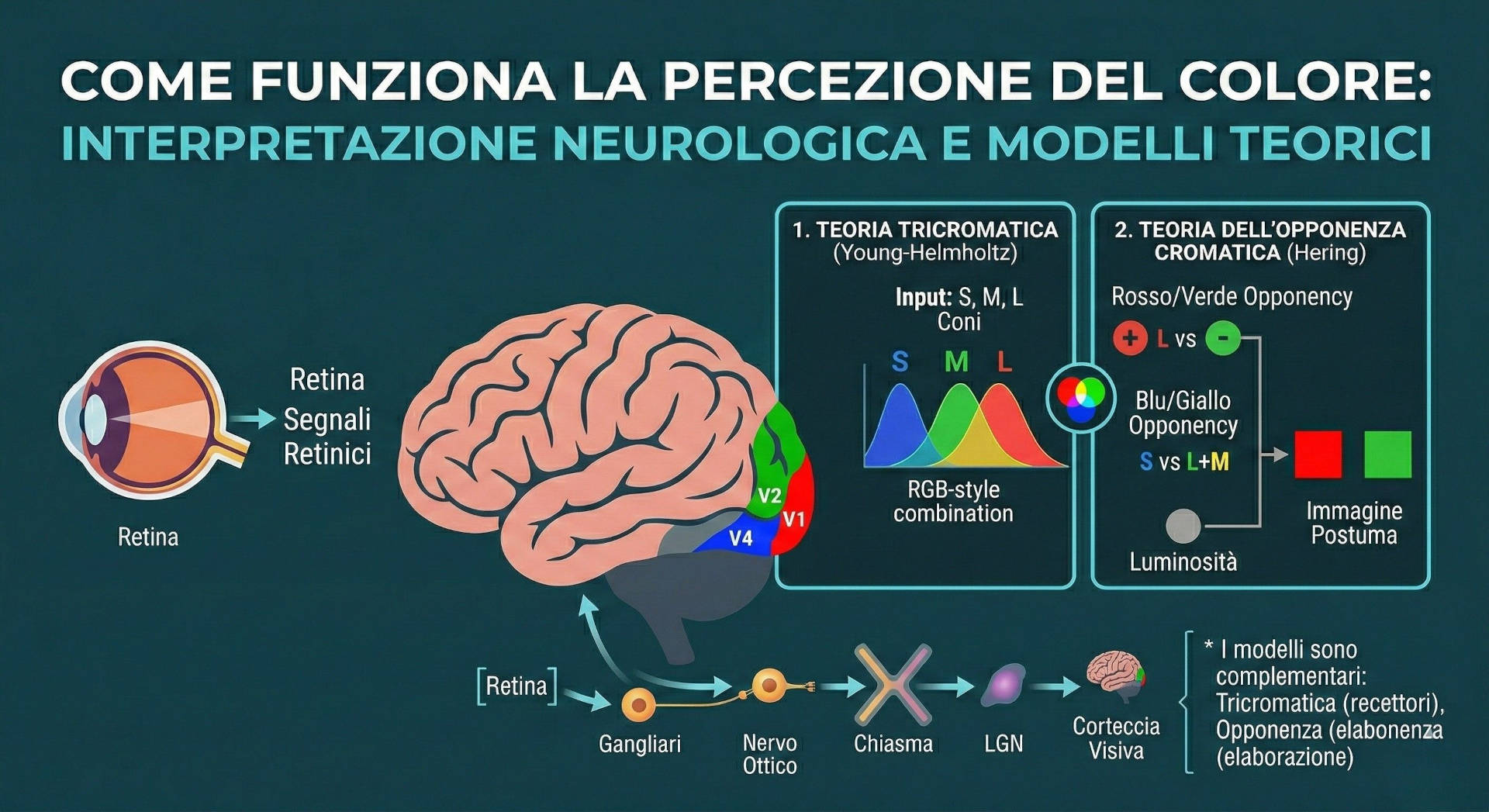
The electrical signals generated by photoreceptors are not transmitted to the brain in raw form but undergo initial processing already at the retinal level through ganglion cells.
Subsequently, visual information is transmitted via the optic nerve to the primary visual cortex (V1) and higher visual areas, where final perceptual interpretation occurs.
Two main theories describe the neural mechanisms of color perception:
- The trichromatic theory of color, formulated by Young and Helmholtz, postulates that the perception of any chromatic hue derives from the combined responses of the three types of cones. This model effectively explains the retinal transduction phase and forms the basis of additive RGB synthesis used in technologies such as displays and digital cameras.
- The opponent-process theory, developed by Hering, describes how the visual system processes cone signals into three opponent channels: red–green, blue–yellow, and light–dark (luminance). This model explains perceptual phenomena such as negative afterimages and the impossibility of simultaneously perceiving hues such as “reddish-green” or “bluish-yellow.” Opponent processing represents a subsequent stage of neural processing, occurring already at the retinal level and further developed in the visual cortex.
These two models are not in conflict but complementary: the trichromatic theory describes receptor responses, while opponent processing explains how the brain processes and interprets these signals.
Understanding both mechanisms is essential for developing colorimetric instruments that faithfully reproduce human visual perception.
Which factors can influence Color Perception
Color perception does not depend exclusively on the spectral properties of the observed object but is significantly modulated by multiple environmental and physiological variables. In industrial quality control, awareness of these factors becomes crucial to ensure reproducible evaluations.
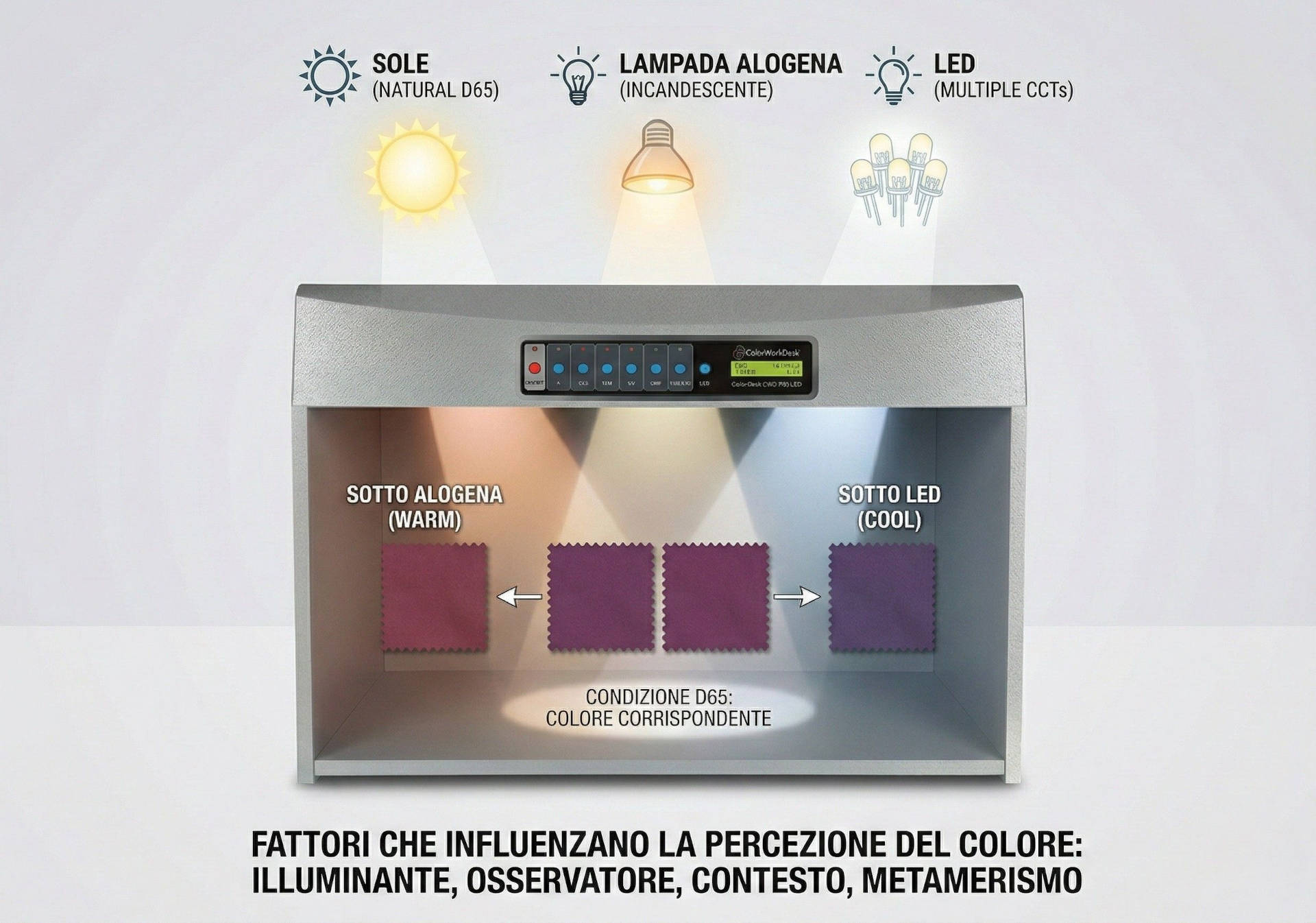
Illuminants are probably the most critical factor. The spectral distribution of the light source determines which wavelengths are reflected or transmitted by the object’s surface and therefore perceived by the observer.
An incandescent light with a color temperature of 2856 K (illuminant A) contains an excess of red components compared to natural daylight (D65 at 6500 K), radically altering the chromatic appearance of the same sample.
This phenomenon finds practical application in standardized lighting booths, where production samples are evaluated under different lighting conditions representative of final usage environments.
The observer constitutes another significant variable. Individual differences in lens optical density, macular pigment concentration, and photoreceptor distribution produce variations in spectral sensitivity among individuals.
The CIE (Commission Internationale de l’Eclairage) has defined standard observer functions at 2° and 10° visual fields to normalize these biological variations, enabling objective comparisons between instrumental measurements.
The visual context profoundly influences chromatic perception through simultaneous contrast and assimilation phenomena. A neutral gray may appear slightly reddish against a cyan background and greenish against a magenta background, despite maintaining identical objective colorimetric coordinates.
Sample size, surface condition (glossy or matte), texture, and viewing angle also influence perceived appearance, even without altering the material’s spectral composition.
Metamerism represents a particular case in which two samples with different spectral compositions appear identical under a specific illuminant but reveal visible differences when observed under different light sources.
This phenomenon, particularly problematic in the textile, automotive, and cosmetics industries, requires evaluation under multiple illuminants to ensure product acceptability under real usage conditions. The instrument that enables proper evaluation of metamerism is the lighting booth.
Which criteria govern Color Perception: from subjective perception to objective measurement
The intrinsic variability of human visual perception has made it necessary to develop objective color quantification systems. In 1931, the CIE introduced the first color space based on psychophysical experiments conducted on human observers, defining color matching functions that correlate visible spectrum wavelengths with the responses of the standard human eye photoreceptors.
The CIE XYZ system represents the fundamental color space, in which any visible color is expressed through three tristimulus values X, Y, and Z. The Y value corresponds to perceived luminance, while X and Z describe chromatic components.
From this space derive more intuitive coordinates such as chromaticity coordinates x and y, used in the CIE 1931 chromaticity diagram, which represents on a two-dimensional plane all visible hues at constant luminance.
Subsequently, more perceptually uniform color spaces were developed, such as CIELAB (Lab*) introduced in 1976.
In this system, L* represents lightness (from 0 black to 100 white), while a* and b* describe the red–green and yellow–blue chromatic axes, respectively.
The main innovation of CIELAB lies in the proportionality between Euclidean distances in color space and differences perceived by the human eye: a ΔE (total color difference) of 1 unit approximately corresponds to the minimum perceptible chromatic difference under controlled conditions.
In the industrial context, instrumental measurement through spectrophotometers eliminates the subjectivity of the human observer, providing reproducible and comparable numerical values.
For industrial applications, where time is critical, more advanced formulas such as ΔE 94, ΔE 2000, or ΔE CMC in variants (1:1, 2:1, 1:2) are often used.
Spectrophotometers measure the spectral reflectance of the sample at regular intervals (typically 10 or 20 nm across the visible range), subsequently calculating colorimetric values according to the selected illuminant, observer, and measurement geometry.
The main measurement geometries include 45°/0°, which simulates human vision by favoring the diffuse component, and integrating sphere geometry d/8°, which can operate including (SCI) or excluding (SCE) the specular component. The choice of geometry influences the result and must be consistent with the industrial application and ISO standard specifications.
This objectification makes it possible to:
- establish precise numerical tolerances for quality control,
- define shared color specifications between suppliers and customers,
- and document chromatic compliance independently of individual visual evaluation.
Three-Dimensional Representation: the Color Sphere and perceptual color spaces
The perception of the colors we see does not follow a linear distribution but requires a three-dimensional representation to be fully described.
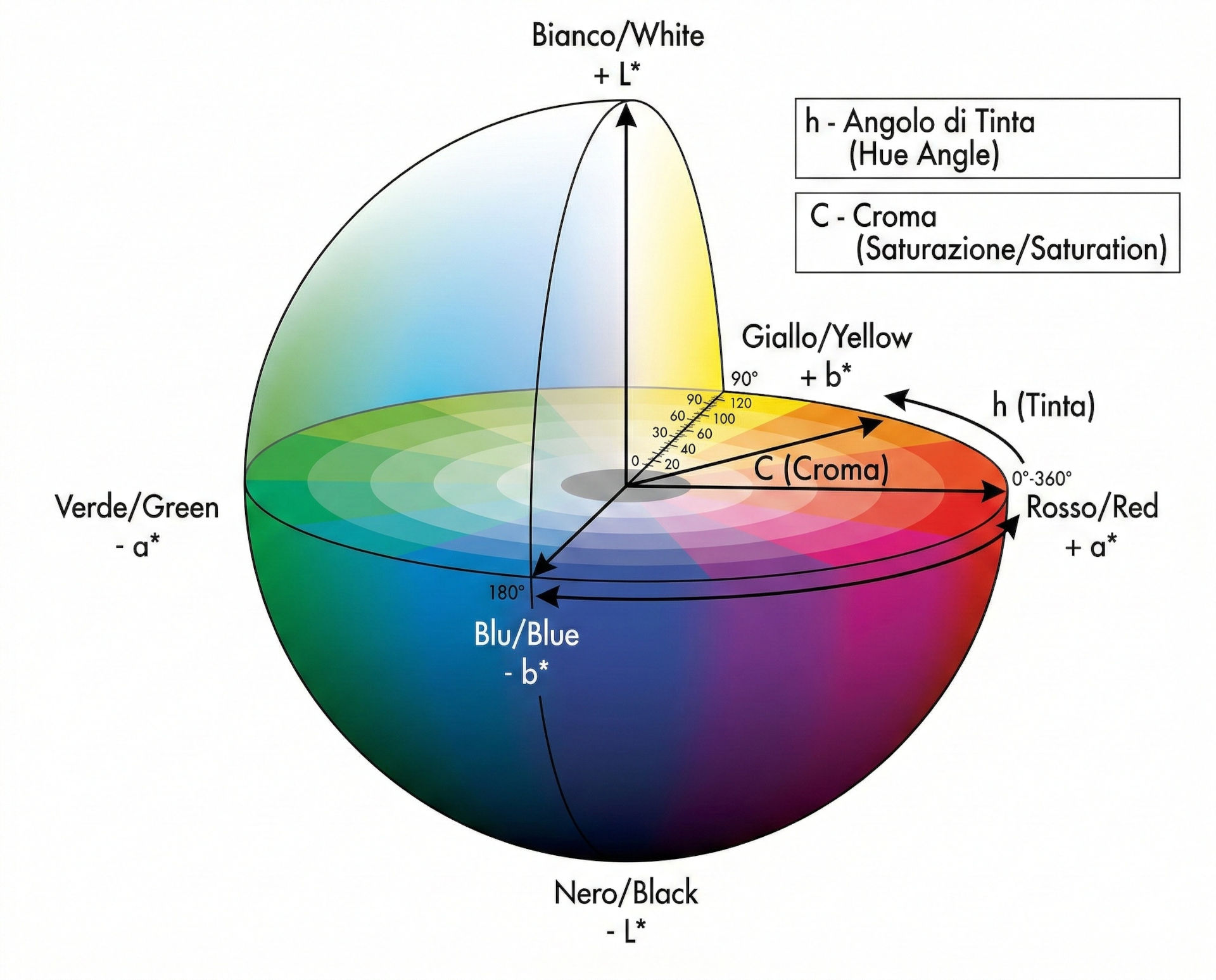
The concept of a color sphere, or more precisely a color solid, makes it possible to organize all perceivable hues according to three fundamental attributes:
- hue,
- chroma (saturation),
- and lightness.
In the cylindrical model derived from CIELAB (LCh° representation), hue is represented by the angle h° around the vertical axis: conventionally 0° corresponds to red (+a*), 90° to yellow (+b*), 180° to green (–a*), and 270° to blue (–b*).
Chroma, expressed as C*, increases radially from the center (neutral gray where a* and b* are close to zero) toward the periphery (saturated colors), while lightness varies vertically from black (L*=0) to white (L*=100).
This three-dimensional structure explains why we can perceive different colors even starting from the same hue: a red may be lighter or darker, more or less saturated, maintaining the same angular position while occupying different coordinates in color space.
The shape of the color solid is not perfectly spherical or cylindrical, but shows irregularities due to the physical limits of pigments and light sources. In particular, highly saturated colors in the yellow region can reach high lightness values, while saturated blues and violets are intrinsically darker at equal perceived saturation.
This asymmetry reflects the characteristics of human color perception and available materials, influencing color formulation strategies in industry.
The role of Illuminants in Industrial evaluation
In quality control, the selection of the appropriate illuminant is not merely a perceptual variable but an operational choice that directly influences the validity of colorimetric measurements and their correlation with the product’s final appearance.
The CIE has standardized numerous illuminants representative of real usage and observation conditions. It is important to remember that a standard illuminant is not a specific physical lamp but a reference spectral distribution used in colorimetric calculations.
The most commonly used standard illuminants in industry include:
- D65 (6504 K): simulates average daylight and represents the most common reference condition for color evaluation in general applications. Particularly relevant for products intended for use in environments with natural lighting or cool-white lamps.
- A (2856 K): reproduces traditional incandescent light, essential for evaluating products observed in domestic environments with warm lighting. The strong red component significantly alters the appearance of materials with selective reflectance in the red region of the spectrum.
- F11 (4000 K): represents tri-phosphor fluorescent lamps used in commercial environments. The discontinuous spectral distribution typical of these sources may reveal metamerism issues not detectable with continuous illuminants.
Industrial practice frequently requires simultaneous evaluation under multiple illuminants to identify metameric pairs and ensure chromatic consistency across different usage scenarios.
Modern spectrophotometers automatically calculate colorimetric values for all standard illuminants from a single spectral measurement, enabling rapid verification without the need to physically change the light source.
Standardization and quality control in the Industrial sector
This approach is particularly effective in managing industrial tolerances, where the acceptability of a color difference may vary significantly depending on the illuminant considered.
A thorough understanding of color perception and its underlying physiological and neurological mechanisms forms the foundation for the implementation of effective quality control systems in modern industry.
Although human visual perception remains the ultimate reference for the aesthetic acceptability of a product, its variability makes it necessary to adopt standardized instrumental measurement methodologies based on defined parameters: illuminant, observer, measurement geometry, color space, and color difference formula.
The integration of visual evaluation and spectrophotometric measurement represents the optimal approach: the former maintains relevance to the final consumer’s perceptual experience, while the latter provides objectivity, reproducibility, and documentary traceability.
CIE standards, continuously evolving to incorporate new knowledge about color perception in the human eye, provide the common language necessary to communicate color specifications throughout the entire production chain, from raw material supplier to finished product.
In the contemporary industrial context, where production cycles are globally distributed and quality tolerances increasingly stringent, the standardization of color measurement is not merely an advanced technological option but an operational necessity.
The ability to numerically quantify color differences, to predict metamerism under different illuminants, and to establish acceptability criteria based on objective data transforms color management from an empirical process subject to personal interpretation into a rigorous and controllable engineering discipline.
Investment in professional colorimetric instrumentation and in the training of technical personnel on the principles of color perception and its measurement therefore represents a strategic element in ensuring competitiveness and quality excellence in industrial sectors where chromatic appearance is a critical attribute of the final product.

Subscribe to newsletter
You might be interested

The Colorimeter: precision and Color control in industrial applications

Metamerism: what It is and how It affects Color Control

ColorWorkDesk: How to Choose a Spectrophotometer

ColorWorkDesk: A Guide to Color Formulation in Colorimetry

Light Booths: the fundamental tool for Color Quality Control

ColorWorkDesk: Measuring Color with Spectrophotometers

ColorWorkDesk: How Spectrophotometers Work

Color Analysis in the Textile Sector: technologies and Industrial Applications
Color Models in Industry: the science behind chromatic perfection

ColorWorkDesk CWD Server: The software that provides colorimetry services

ColorWorkDesk: The Innovative Software for Color and Paint Management

ColorWorkDesk: your colorimetry with our consulting
Ask for a free consultation
Our experts will contact you to show you a demo of our products