


10-10-2023
ColorWorkDesk: The Innovative Software for Colour and Paint Management

URAI has developed an intuitive, technological, and essential tool for every company producing colours and paints.
The colourimetry sector, increasingly influenced by digital innovations, required a tool capable of simplifying and optimising operators’ work. To meet this need, URAI created ColorWorkDesk, a line of solutions designed to meet all industrial colourimetry requirements.
In this article:
- The First Problem to Solve: Is Colour Subjective?
- Communicating Colour: Recognised Methods
- The Spectrophotometer: An Essential Tool for Measuring Colour
- ColorWorkDesk Revolutionizes Colourimetry and Simplifies Work
- 5 Steps for Your Colourimetry: How the Software Works
- Colour at Your Fingertips: When Software Communicates Effectively

Light and Perception: How Colour Is Born
When talking about colours, one cannot avoid discussing the very essence of every colour: light.
To understand how colours are born, it’s essential to first grasp what light is and how it works.
Technically, what we call light is nothing more than the visible portion of the electromagnetic spectrum perceived by the human eye, ranging from wavelengths of 400 to 700 nanometers.
An interesting characteristic of light is its ability to interact with surrounding matter in various ways, one of which—selective absorption—is directly relevant here. Selective absorption allows us to perceive colour, or rather, to perceive certain wavelengths of light.
We perceive only the wavelengths that are not absorbed by matter. Consequently, what we see—the colour of an object—are actually the wavelengths reflected by the object and returned to our eyes.
This concept is confirmed when we perceive the colour “black.” When an object appears black, it means it has absorbed all the wavelengths of the light hitting it. Essentially, the object has absorbed all the colours.
The First Problem to Solve: Is Colour Subjective?
If the perception of colour depends on our eyes’ ability to capture the wavelengths reflected, emitted, or transmitted by an object, it is also true that not all eyes have the same capabilities.
The interaction between light and the retina’s photoreceptors is highly subjective. Colour blindness, for instance, is perhaps the most evident example of the varying perceptual abilities of human eyes.
Since colour perception is subjective, it becomes critical for professionals in the colour field to find a universal and unequivocal way to measure, quantify, and communicate colour.
Communicating Colour: Recognized Methods
A numerical method for expressing color has been found—in fact, two methods have been developed over time.
The Commission Internationale de l’Eclairage (CIE), an international organisation studying light and colour, created two models still recognised as among the most valid and widely used for communicating colour:
- The Yxy colour space: Developed in 1931, it is based on the XYZ tristimulus values defined by the CIE.
- The Lab colour space*: Better known as CIELAB, it was introduced in 1976 and is designed to better standardise colour differences relative to visual perception.
The Spectrophotometer: An Essential Tool for Measuring Colour
This brings us to the next question: “How can we measure colour unequivocally?”
To assist operators, tools have been specifically designed to measure and control colour quality.
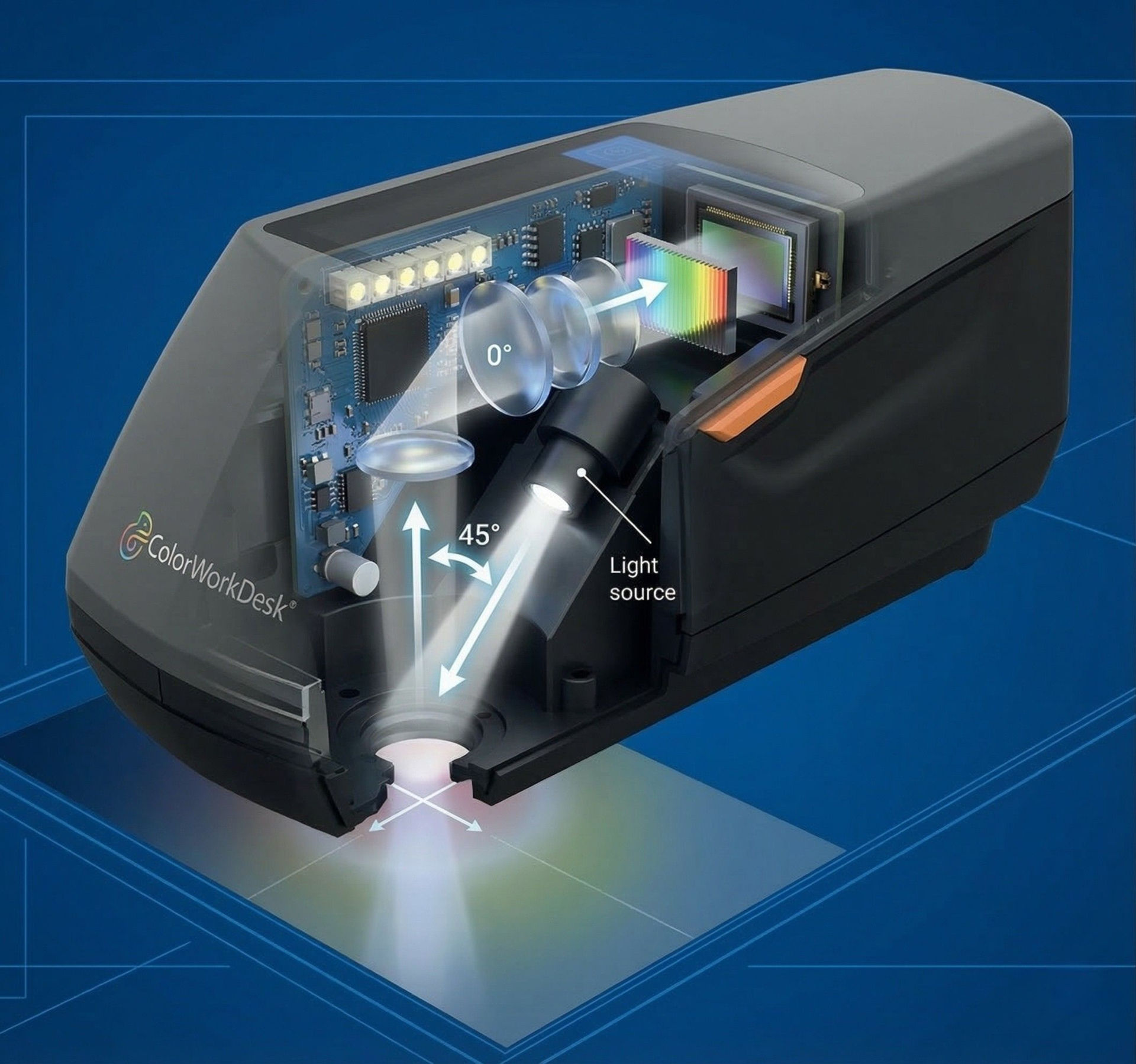
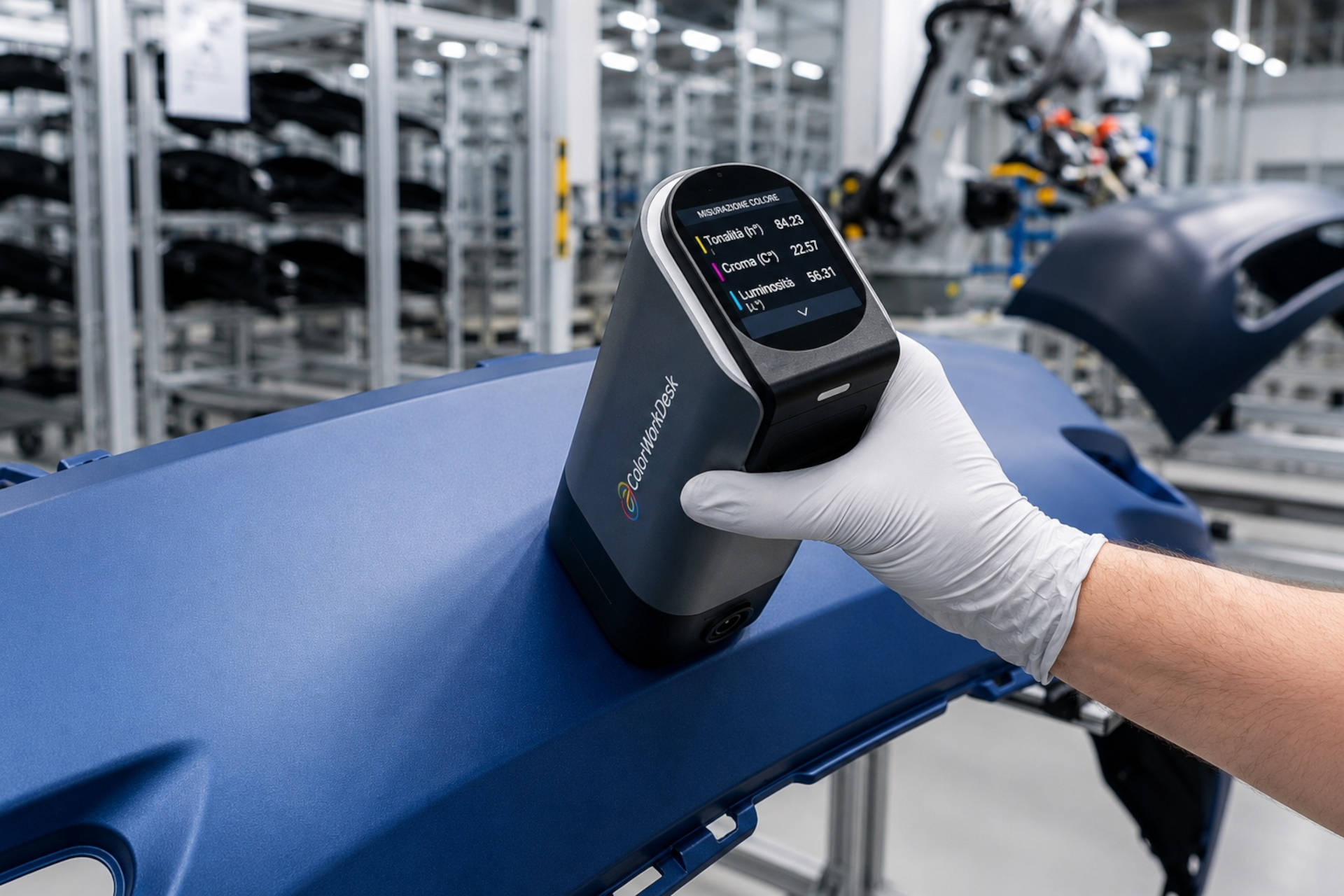
Spectrophotometers are the devices used in colourimetry to capture colour and identify it uniquely, enabling the quantification of differences or finding matches between different colours. These precise colour quantification capabilities allow operators to maintain the uniformity of a specific colour throughout all process stages.
Choosing the right model for specific needs and correctly configuring it are therefore fundamental steps for daily operations.
ColorWorkDesk Revolutionizes Colourimetry and Simplifies Work
The ColorWorkDesk line offers a perfect mix of tools, software, and technologies, ensuring high precision in measuring, controlling, and managing colour.
The wide range of next-generation benchtop and portable spectrophotometers, equipped with LED or XENON physical illumination technology, provides ideal support for the Color Quality Control Software.
For operators, the system is intuitive and easy to use. It supports various reading geometries (d/8° sphere and 45°/0°) and features modern Bluetooth and USB connections, enabling seamless communication between different ColorWorkDesk spectrophotometer models and the desktop software for PCs or the app for smartphones and tablets.
While spectrophotometers are highly performant, they serve as support tools. The real strength of the system developed by URAI lies in its software applications for color analysis and management.
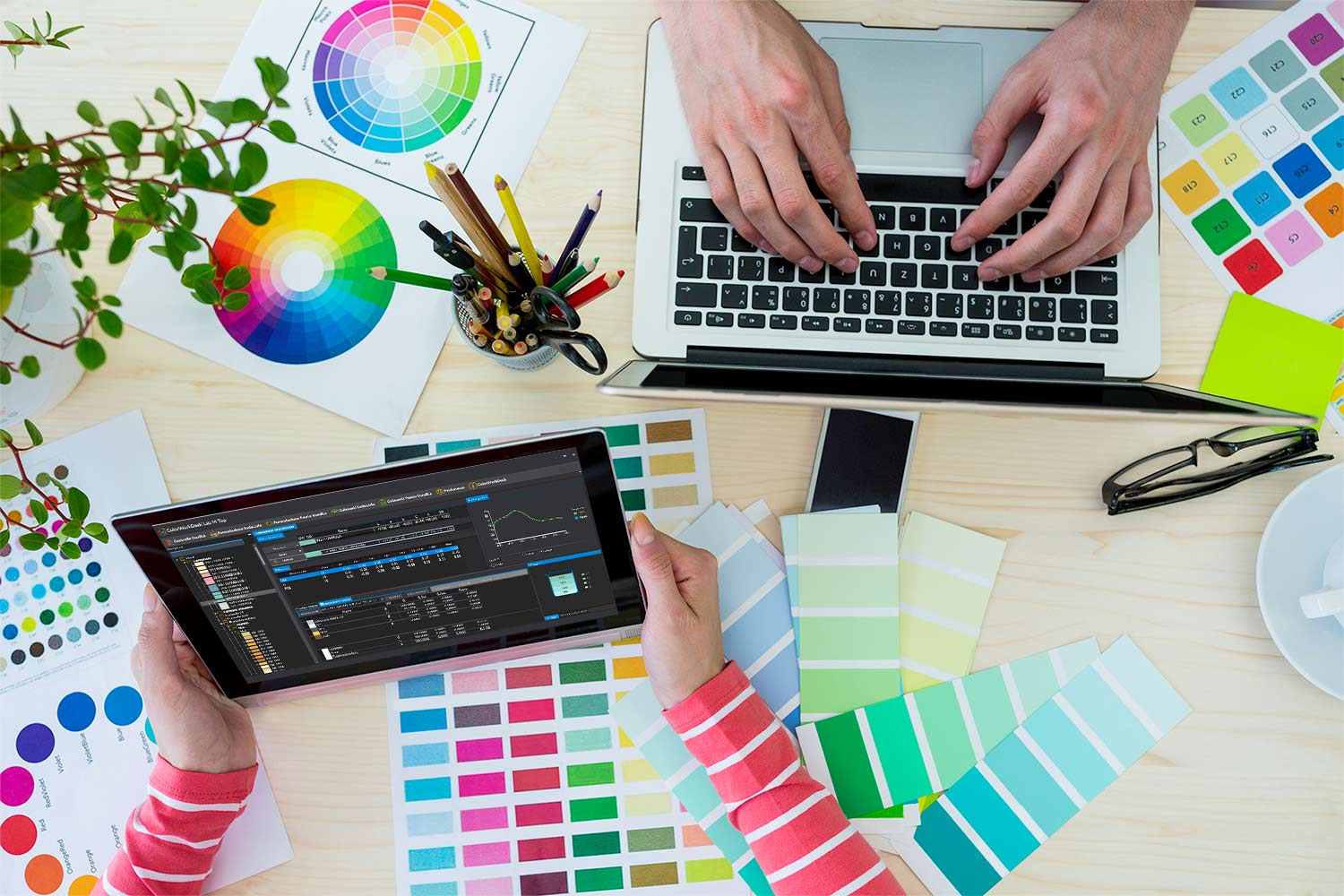
These applications form a complete, versatile, and user-friendly system that effectively addresses diverse operational needs, thanks to their modern, intuitive graphics and high computational speed.
In short, if the goal was to simplify and streamline operators’ work, it has been achieved. Now, it’s time to understand how this software works and how operators can use it most effectively.
5 Steps for Your Colourimetry: How the Software Works
URAI’s system is well-established, with the software performing precise and fast operations summarised in five steps:
- Input: Using spectrophotometers, the colour is captured and sent to the database.
- Learning: Once the individual components of a formulation are acquired, they are stored in the database for future use.
- Processing: The system uses optimized calculation speeds, powered by algorithms developed and tested in URAI’s colour laboratories.
- Output: The system delivers the requested colour formulation in just a few seconds.
- Management: The Data Navigator within the software enables operators to efficiently manage the measurements, organizing them into folders and subfolders.
These steps are made possible by a central server where all formulation results requested by various ColorWorkDesk users are collected, managed, and shared.
Colour at Your Fingertips: When Software Communicates Effectively
By leveraging cloud technology, the system centrally manages all formulation requests, offering all operators a continuously updated and shared database. This database is accessible via the convenient app, developed to make work even smarter and faster.
Operators simply need to capture the coluor using a spectrograph and send a processing request via the client software installed on their device. The central server processes the input and returns the result in seconds.
Operators can upload and store their formulations in the central database, manage them as needed, and share them with other connected clients while also benefiting from others’ shared formulations.
This creates a virtuous cycle of collaboration within the community, speeding up the software’s performance to the advantage of everyone’s work.

Subscribe to newsletter
You might be interested
The Densitometer in ink control: measurement, operation, and applications in industrial printing
The ability to accurately measure ink behavior during the printing ...

Metamerism: what It is and how It affects Colour Control
In the field of industrial colorimetry, metamerism represents one of ...
Color Attributes: Hue, Chroma and Lightness in Industrial quality control
When a company decides to establish a color standard for ...
ColorWorkDesk: Measuring Colour with Spectrophotometers
The study of colour is a more complex field than ...

Colour Spectrophotometry: reading colour through light
Colour Spectrophotometry is today one of the most reliable and ...
Ask for a free consultation
Our experts will contact you to show you a demo of our products