


16-04-2026
Colour Spectrophotometry: reading colour through light

Colour Spectrophotometry is today one of the most reliable and widely used measurement techniques for describing colour in an objective and reproducible way.
Unlike visual observation, which is strongly influenced by lighting conditions, environment, and individual perception, spectrophotometry makes it possible to translate colour into measurable numerical data. This is essential in industrial sectors such as paints, coatings, plastics, materials, and packaging, where colour consistency is a fundamental quality requirement.
In its application context, spectrophotometry is not intended for chemical analysis of matter, but for the study of the behaviour of visible light when it interacts with a surface or a material.
Through this interaction, it is possible to describe colour in a scientific manner, making it comparable and stable over time.
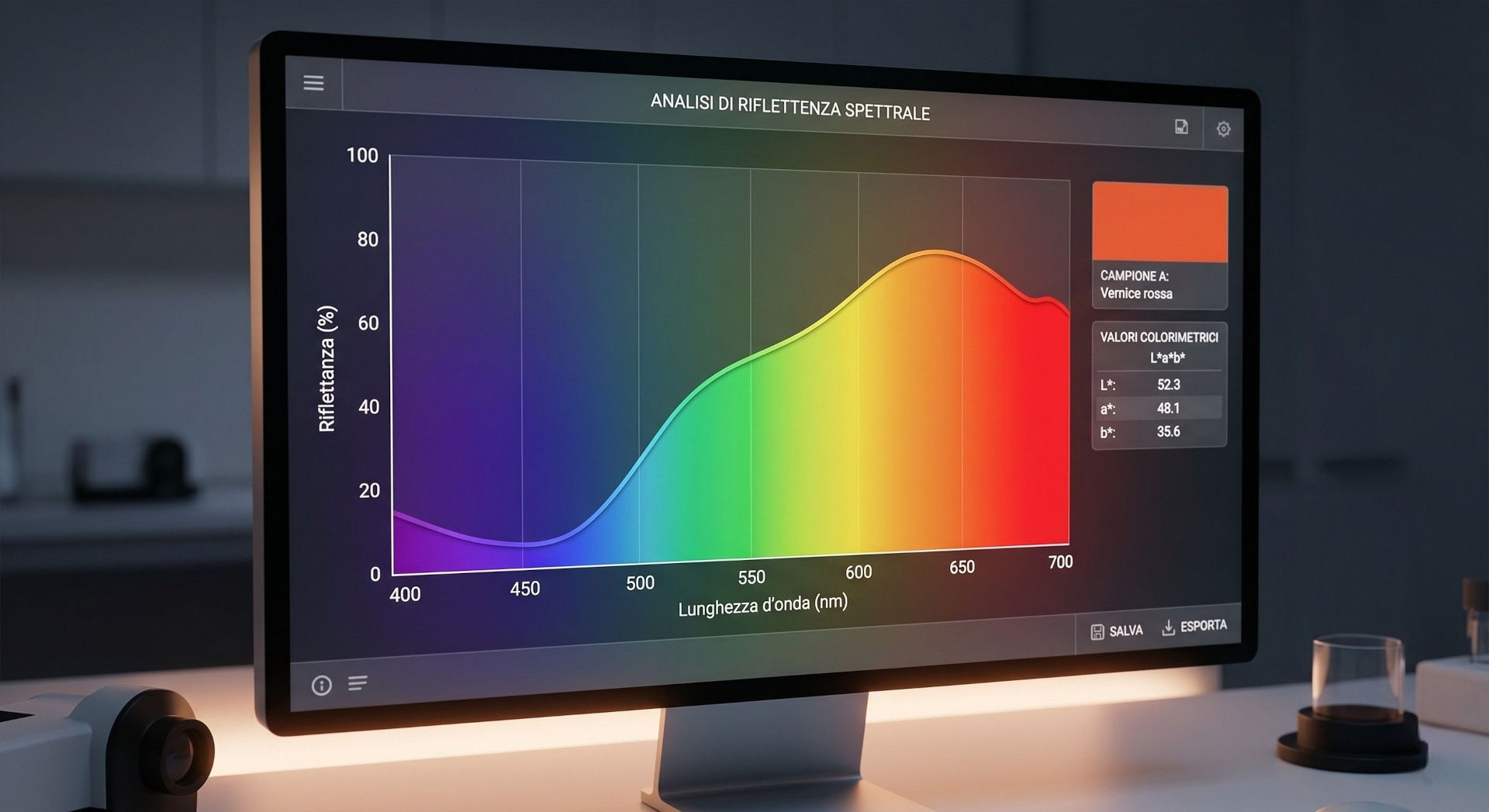
Colour spectrophotometry is an instrumental technique that measures how a material reflects or transmits light in the visible spectrum, between 400 and 700 nanometers.
What is Colour Spectrophotometry and what are its fundamentals
The basic principle is that every colour can be described as a spectral distribution of the light reflected or transmitted by an object.
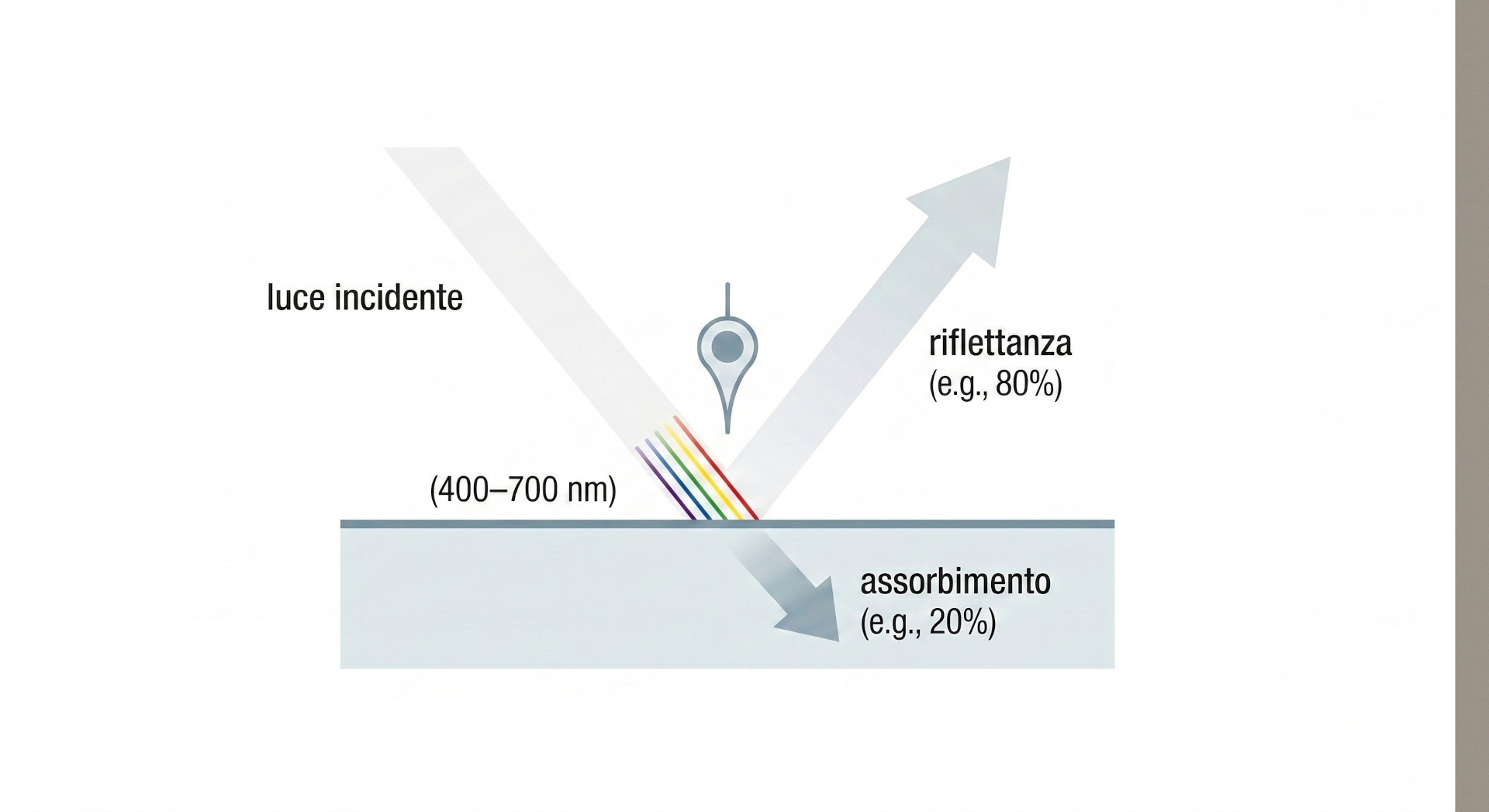
When a light source strikes a surface, part of the light is absorbed by the material and part is reflected or transmitted. The distribution of this light, measured wavelength by wavelength, constitutes the true chromatic identity of the sample.
Unlike chemical spectrophotometry, colour spectrophotometry does not measure absorbance and does not determine concentrations.
The goal is not to identify the chemical composition of matter, but to describe colour as it is perceived by the human eye.
Differences compared to Chemical Spectrophotometry
Unlike chemical spectrophotometry, in colour spectrophotometry absorbance (absorption of electromagnetic radiation for quantitative purposes) is not measured, and concentrations are not considered.
The goal is not to determine the chemical composition of a material, but to describe its colour as perceived by the human eye, since this discipline is exclusively dedicated to the study of visible light and the description of colour.
When Colour Spectrophotometry is used
Colour spectrophotometry is employed whenever it is necessary to measure, compare, or reproduce a colour in an objective and reliable way, eliminating the subjectivity of human visual perception.
This technology is essential in several fields:
- Industrial quality control: it allows verification that products maintain consistent colouration across different batches, identifying even minimal colour variations that the human eye may not immediately perceive.
- Colour formulation and matching: it enables analysis of a target colour and the development of the exact formula of pigments, colourants, or inks required to accurately reproduce it on different materials and substrates.
- Verification of colour reproducibility: it ensures that colour remains consistent over time and under different production conditions, guaranteeing uniformity between samples, prototypes, and final production.
The industries that rely most heavily on this technology include:
- the textile industry,
- automotive,
- cosmetics,
- food,
- paints and printing,
where colour accuracy represents an essential quality requirement and often a key brand differentiator.
What Colour Spectrophotometry measures and the instruments used
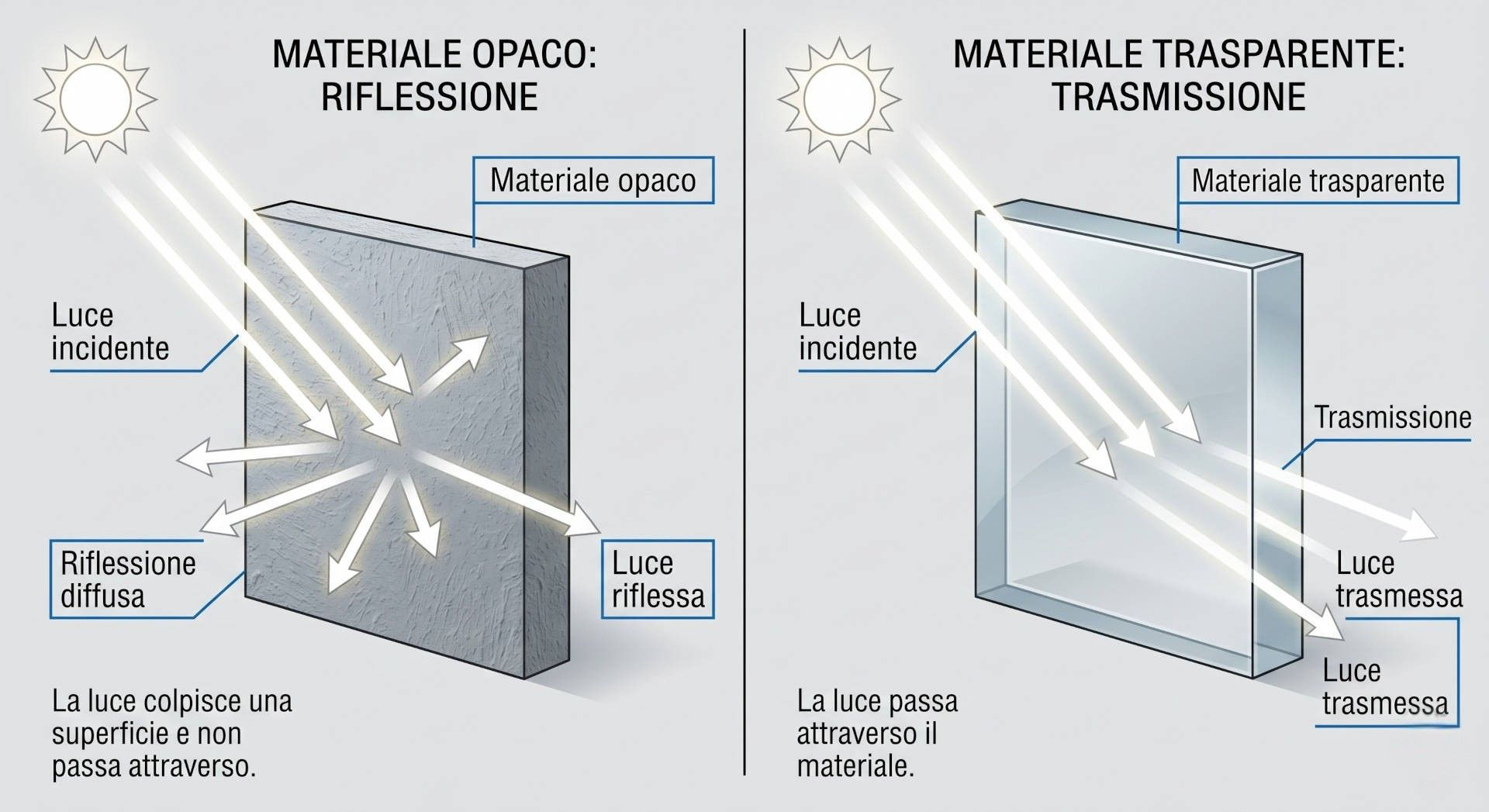
Colour spectrophotometry measures the reflectance of opaque surfaces and the transmittance of transparent materials.
Measured parameters
- Reflectance: the percentage of light reflected by opaque surfaces at each wavelength of the visible spectrum. This measurement is fundamental for solid samples such as textiles, paints, plastics, paper, and cosmetic products.
- Transmittance: the percentage of light that passes through transparent or translucent materials, such as glass, plastic films, liquids, gels, and solutions. It allows characterisation of both the colour and the degree of transparency of the material.
- From these spectral measurements, standardised colourimetric coordinates (L*a*b*, XYZ, RGB) and colour difference indices (ΔE) are derived, which are essential for quality control and unambiguous colour communication.
Instruments used
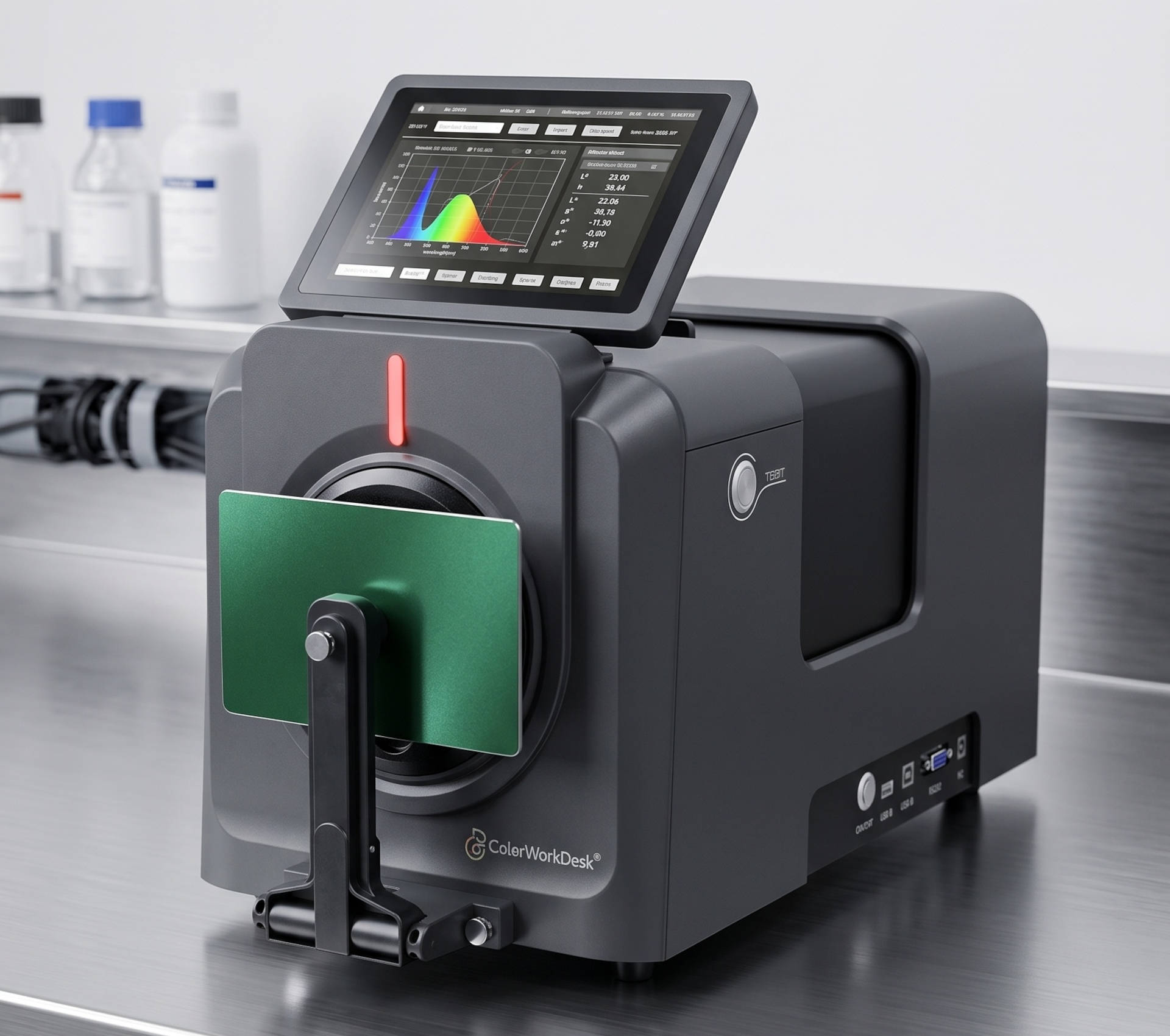
Modern spectrophotometers make use of advanced illumination technologies:
- Multispectral LED: ensures stability, long lifespan, and instant switch-on, with reduced energy consumption
- Xenon lamps: provide a continuous and uniform spectrum that faithfully simulates daylight (D65 illuminant)
These instruments are designed to operate exclusively in the visible region (approximately 380–780 nm), corresponding to the sensitivity of the human eye.
There are different measurement geometry configurations (e.g. 45°/0°, d/8° with integrating sphere) to adapt to the specific characteristics of the analysed materials, such as surface texture, gloss, or metallic effects.
How Colour Spectrophotometry works
The instrument illuminates the sample and measures the returned light at each wavelength between 400 and 700 nanometers.
The result is a spectral curve that describes the chromatic behaviour of the material.
In the coatings industry, reflectance data are often processed using the Kubelka–Munk model, expressed as the K/S function, to support colour formulation systems.
The advantages in Professional Applications
Colour spectrophotometry is an indispensable tool for numerous industrial sectors thanks to its ability to provide objective, repeatable, and standardised measurements.
Unlike visual evaluation, which is subject to individual variability and environmental conditions, this technology ensures extreme precision in colour quantification, eliminating interpretative discrepancies between operators and production sites.
In the printing and packaging sector, for example, it enables brand consistency to be maintained across different print runs and substrates, while in the textile industry it ensures colour uniformity between production batches separated in time and location.
The ability to create and manage digital colour libraries greatly facilitates quality control, allowing rapid checks against reference standards and drastically reducing production waste caused by colour deviations.
In addition, spectrophotometry significantly accelerates colour formulation processes: what once required hours of manual trials can now be optimised in just a few minutes thanks to colour matching algorithms that calculate the most efficient recipes.
From an economic perspective, investment in this technology results in substantial savings derived from:
- reduction of material waste,
- minimization of rework,
- optimisation of product development time.
All of these factors make spectrophotometry not only a tool for technical precision, but also a strategic asset for business competitiveness.
Further information
Instrument calibration
Calibration is performed using a certified white tile and a black trap, ensuring repeatability and measurement reliability.
Difference between Colourimetry and Colour Spectrophotometry
Traditional colourimetry uses filters and provides synthetic values, while colour spectrophotometry analyses the entire visible spectrum, delivering a more complete and accurate description of colour.
FAQ
When was spectrophotometry applied to colour measurement?
The application of spectrophotometry to colour measurement developed during the 20th century, with the introduction of the first instruments capable of analysing surface reflectance in the visible range.
What is transmittance in Colour Spectrophotometry?
Transmittance represents the fraction of visible light that passes through a material and is fundamental for measuring the colour of transparent or semi-transparent materials.
What is absorption spectrophotometry?
It is an analytical technique used in chemistry, but it is not applied to colour measurement, which is instead based on reflectance or transmittance.
What is visible-range Colour Spectrophotometry?
It is a technique that measures the behaviour of light between 400 and 700 nm, the only region relevant for colour perception.
Which principle is used in Colour Spectrophotometry?
The measurement is based on the spectral distribution of light reflected or transmitted by the sample.
What is the K/S function used for?
The K/S function describes the optical behaviour of pigments and forms the basis of colour formulation systems.
What is Chemical Spectrophotometry?
It is an analytical technique for concentration determination, different from colour spectrophotometry.
How is a Colour Spectrophotometer calibrated?
Calibration is carried out using a certified white tile and a black trap.
How many reflectance points are required to draw a colourimetric curve?
It depends on the instrument resolution, which can acquire 8, 16, or up to 31 spectral points.

Subscribe to newsletter
You might be interested
Colour Models in Industry: the science behind chromatic perfection
Colour communication represents a fundamental challenge for companies operating in ...

Color Attributes: Hue, Chroma and Lightness in Industrial quality control
When a company decides to establish a color standard for ...

ColorWorkDesk: How to Choose a Spectrophotometer
When it comes to choosing a spectrophotometer, the first step ...

ColorWorkDesk: A Guide to Colour Formulation in Colourimetry
Colour is everywhere around us—in the clothes we wear, the ...
Inside the Colour Spectrum: from light to quality in Industrial processes
The colour spectrum is one of the fundamental concepts of ...
Ask for a free consultation
Our experts will contact you to show you a demo of our products